ADVOCACY
RHEUMATIC DISEASES OF CHILDHOOD
Arthritis and other rheumatic diseases does not discriminate people of all ages, racial, ethnic and economic populations.
“Arthritis” = Inflammation of a joint
More than 100 specific diseases
Juvenile Rheumatoid Arthritis
Juvenile Scleroderma
Juvenile Ankylosing Spondylitis
Juvenile Dermatomyositis
Juvenile Lupus
MYTH OR FACT ~
Myth ~ Arthritis does not affect children
Fact ~ About 300,000 children in the U.S. have some type of juvenile arthritis.
Myth ~ Alright then…Juvenile rheumatic diseases are still very uncommon, right?
Fact ~ Juvenile arthritis is more common in childhood than:
*Epilepsy (seizures)
*Cerebral Palsy
*Sickle Cell Disease
*Muscular Dystrophy
*Cystic Fibrosis
Arthritis: Adult Demographics
It is estimated that by the year 2020 nearly 60 million americans will be affected by arthritis and other rheumatic diseases. Arthritis afflicts about one in every 6 people in the U.S. and one in 3 families.
Myth ~ Juvenile rheumatic diseases do not cost society very much.
Fact ~ Children with activity limitations are reported by the NHIS* to consume a disproportionate share of health care resources, including over twice as many physician services and over seven times as many hospital services for children.
*National Health Interview Survey
My Day On Capitol Hill
By, BJ Gaither

The morning of February 23 I was on my way to Washington D.C. for the first time. I was so excited!
The next day we went to a meeting with the American College of Rheumatology. We talked about our big day on Capitol Hill. I got to meet all kinds of nice people who flew in from all over the United States. There was only one other kid besides me there, and the rest were adults with some from of arthritis and doctors. Later that evening we got to go to a dinner reception with everyone. I enjoyed talking to some of the adults. They were very nice.
The next morning we had a quick breakfast with everyone and then we broke off into our little groups to go to Capitol Hill. My mom, Roxy, and I 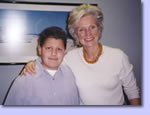 represented California. I met Congresswoman Jane Harmon. She is a very nice lady. She told me that I was doing a good job speaking about my disease. I should be proud of myself. I got the chance to speak out about my disease, how it makes me feel, and why we need research and more pediatric rheumatologist. The other offices we visited for California we spoke to the Senator's legislative assistants. They all listened. It made me feel important to be able to speak out and express how I feel. represented California. I met Congresswoman Jane Harmon. She is a very nice lady. She told me that I was doing a good job speaking about my disease. I should be proud of myself. I got the chance to speak out about my disease, how it makes me feel, and why we need research and more pediatric rheumatologist. The other offices we visited for California we spoke to the Senator's legislative assistants. They all listened. It made me feel important to be able to speak out and express how I feel.
After we met with the California Senator's legislative assistants I got to go to the Air & Space Musuem. It was cool. They had space stuff from Apollo 11 and Apollo 13 and war stuff. Later that day I aslo got to see the White House.
When we left the museum we went back to Capitol Hill to continue on with our mission. We visited the Senator's offices who did not have a pediatric rheumatologist in their state. It was important to let them know their state did not have a pediatric rheumatologist and why its important they do. It was a long eight hours on Capitol Hill. By the end
of the day my legs were hurting so bad I couldn't wait to get into a taxi and back to the hotel.
 I appreciate the American College of Rheumatology for inviting me, my mom, and Roxy to Washington D.C. to be an advocate for arthritis, as well for juvenile scleroderma on Capitol Hill. It was a learning experience for me to have the chance to do some public speaking as well as educational. I appreciate the American College of Rheumatology for inviting me, my mom, and Roxy to Washington D.C. to be an advocate for arthritis, as well for juvenile scleroderma on Capitol Hill. It was a learning experience for me to have the chance to do some public speaking as well as educational.
I was heard on Capitol Hill!!!! |
Pediatric Rheumatology – Underserved Nationally ~
Children’s Health Act of 2000 (H.R. 4365)
The U.S. Congress has legislated that the Secretary of Health Human Services and the National Institute of Arthritis and Musculoskeletal and Skin Disease evaluate the health care needs of children with arthritis and related conditions and to train and develop pediatric rheumatologist.
Authorized sums as may be necessary for each of the fiscal years of 2001 through 2005.
Physician shortage is dire:
*There are ONLY 179 Board-certified Pediatric Rheumatologist in the U.S.
*Several states have NO Pediatric Rheumatologist at all, including: Maine, North Dakota, Idaho, Arizona, New Mexico and Nevada.
Doctor shortage: WHY?
*Lack of training:
36% of U.S. Medical Schools have NO Pediatric Rheumatologist on staff, including 42% of the 40 primary care schools.
*Lack of mentoring
*Lack of financial support
*Consequently, many practicing health care professionals are weak in their rheumatic disease diagnostic and treatment skills.
Children are NOT ‘little adults’
Juvenile forms can pose different challenges than adult disease. Juvenile arthritis and related conditions affects children’s growth and development. Children have unique challenges – physically & emotionally. This is why it is important to have Pediatric Rheumatologist seeing our children. Perhaps there needs to be training for Adult Rheumatologist in Pediatric Rheumatology.
Education ~
The school’s dilemma
*Unless children and their families disclose their diagnosis, school teachers and administrators are confused about their student’s juvenile rheumatic diseasese.
*Conversely, many teachers inappropriately expect normal physical performance from children with juvenile rheuamtic diseases, including juvenile scleroderma.
The resolution to this dilemma lies in the community and school education about juvenile rheumatic diseases.
What do these diseases look like? If we are successful, hopefully you will never see them.
While waiting for a cure there will always be a child with a juvenile rheumatic disease who will have reduced participation in peer activities, absenteesim from school or limited career options.
Research ~
Research on juvenile arthritis and other rheumatic diseases: Does it exist?
Children’s Health Act 2000 (H.R. 4365)
The Director of the Institute, in coordination with the Director of the National Institute of Allergy and Infectious Diseases, shall expand and intensify the programs of such Institutes with respect to research and related activities.
Research for Juvenile Rheumatoid Arthritis, Juvenile Dermatomyositis and Neonatal Lupus is currently active. For other rheumatic diseases, there is NOT research being done.
For other rheumatic diseases such as, Juvenile Scleroderma, there is NOT research being done. Juvenile Scleroderma is relatively unknown and underfunded. Researchers believe that both environmental and genetic factors may play in Scleroderma. Funding for a registry will accelerate basic and epidemiologic research on Juvenile Scleroderma. Information to be collected for the registry would establish diagnosis of Juvenile Scleroderma and appropriate information to define research purposes. It would be a benefit from these investments in clinical decision making and to enhance the national research effort in Juvenile Scleroderma.
It is essential to keep funding research for juvenile arthritis and other rheumatic diseases for effective treatment that can help restore or improve their chances to enjoy their childhood.
Our children are our future!
Resources ~
American College of Rheumatology, National Institute of Arthritis and Musculoskeletal & Skin Diseases, American Academy of Pediatrics/Rheumatology, Journal of Rheumatology, Arthritis Foundation, Juvenile Scleroderma Network, Pediatric Rheumatology, and Children’s Health Act of 2000(H.R. 4365).
How you can help by being an advocate to 300,000 children
who live with a juvenile rheumatic disease!
Raising a child with a juvenile rheumatic disease is challenging. There are times when you, the parent, are the child’s only advocate. Here’s some information on how you can help further government funding for research and development for treating kids with juvenile rheumatic disease.
|
|
Please, take the time to write your congressmen to make them aware –
*How important research is
*We need more Pediatric Rheumatologist
*Tell your legislation that Will Leave No Child Behind
*Tell your elected officials to support policies for children
*Elect candidates who support children’s issues
Finally, encourage your friends & family to get involved too!!! |
There are other ways to get involved with advocacy by visiting the following websites:
American College of Rheumatology (ACR) – Legislative Action Center
ACR gives you everything you need to know on how to advocate. You can join their list of key contacts. ACR keeps you informed in what’s happening in Washington, D.C.
The American Autoimmune Related Diseases Association (AARDA)
AARDA takes positions from time to time on health related issues
and legislation.
Being an Advocate doesn’t stop at contacting your congressmen…
Write a letter to your local newspaper editor!
For more information on Juvenile Scleroderma, contact:
Juvenile Scleroderma Network, Inc.
1204 W. 13th Street, San Pedro, CA 90731
Tel: (310)519-9511 (Pacific Time)
24 Hour Support Line: 1-866-338-5892 (toll-free)
Speak to another JSD parent for emotional and logistical support
provided by home-based JSD volunteers. For medical advice, please
contact your child's physician.
Non-Medical Questions or Comments? Click Here
Medical Questions? The Doctor's In: Q & A

|